AI as a Tool, Not a Feature: an ethical addition to JLAM's dietary support
JLAM
(Je Leefstijl Als Medicijn) is a Dutch community that helps people prevent and reverse lifestyle-related illness by treating food and daily habits as medicine
Headquarters
Netherlands
Industry
Health & lifestyle
Services
- UX research
- AI ethics & privacy
- App design
- Prototyping
- User testing
The challenge
People with diabetes don't lack dietary information - they struggle to judge its credibility. Advice from clinicians, guidelines, communities, influencers and AI often contradicts itself, and JLAM's own community app raised real ethical concerns: sensitive health data posted publicly, friend-matching without consent, and AI assistants that turned out to be ChatGPT with a persona layer.
Solution
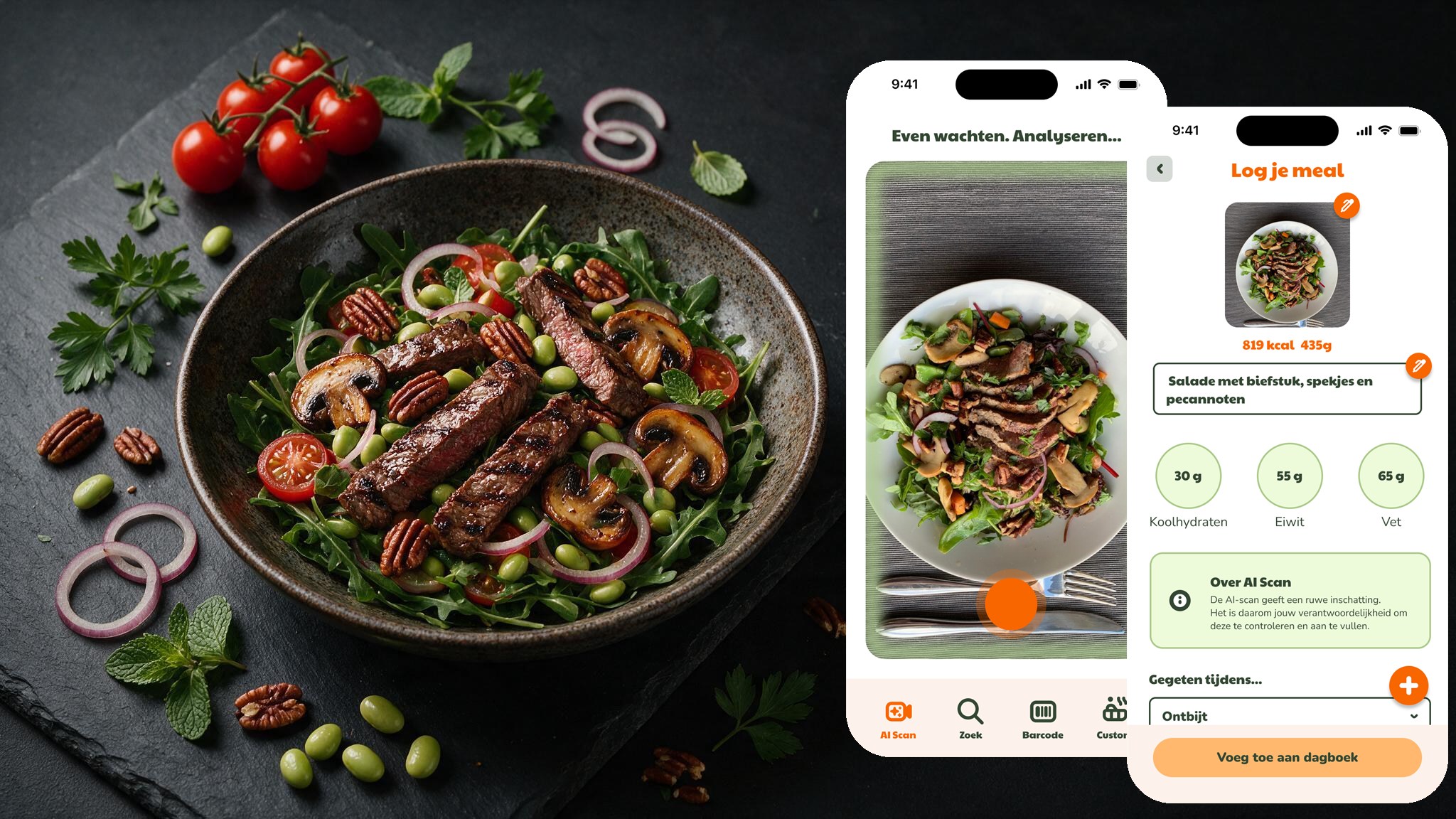
A redesign of JLAM's app where AI is a tool, not a feature: a MealCoach with four ways to log a meal (AI being just one, clearly-labelled option), health data owned by the user instead of the forum, and continuous AI disclosure. Validated over three testing rounds, ending at 80-93% feature success and an overall app score of 4.40/5.
Try MealCoach AI yourself
This is the app's meal-logging agent, rebuilt to run right here on the page. Upload a photo of a meal or scan a barcode: AI vision estimates the ingredients and macros, you review and correct anything it got wrong, and the coach explains what the numbers mean for a diabetic diet. AI as a tool, with you in control - and below the demo, the same flow as it looks in the V3 prototype.


Upload a photo
of your meal
or barcode
Click anywhere or drop an image here. You can select several photos at once.
Upload a photo
of your meal
or package
AI Vision Analysis
AI Vision Analysis
One of the observed
ingredients from your meal is:
I’m observing about:
AI Vision Analysis
Are there any ingredients I
didn’t observe?
Diabetic
Guidance
Hmm, that
didn’t work
Discover
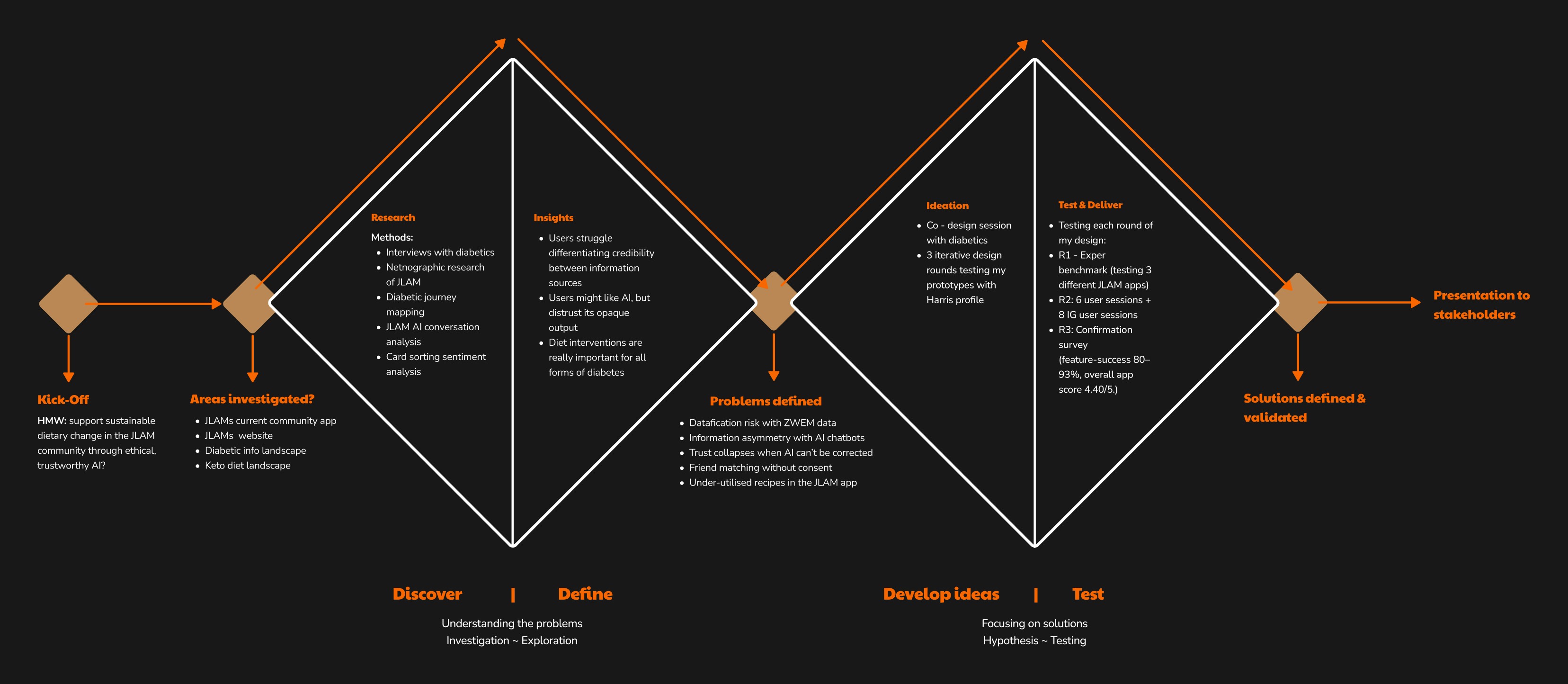
I involved real users from the very start: four in-depth interviews (a reversed prediabetic, two adults with Type 1 diabetes and a diabetes nurse), netnographic research inside JLAM's community app, a journey map of the diabetic experience from first symptoms to long-term self-management, and a study of the diabetic information and keto landscapes JLAM operates in.
The research showed diabetes management as a constant negotiation between medical authority and lived experience: people don't lack dietary information - they struggle to judge its credibility, with Type 1 and Type 2 advice dangerously conflated along the way.
A keyword analysis of 13,333 real user messages sent to JLAM's Lampie AI confirmed the direction: food and nutrition dominated (44%), followed by health metrics and body measurements (33%). Users were already treating the AI as a dietary assistant and self-monitoring tool - without the structure, memory or transparency to support it.
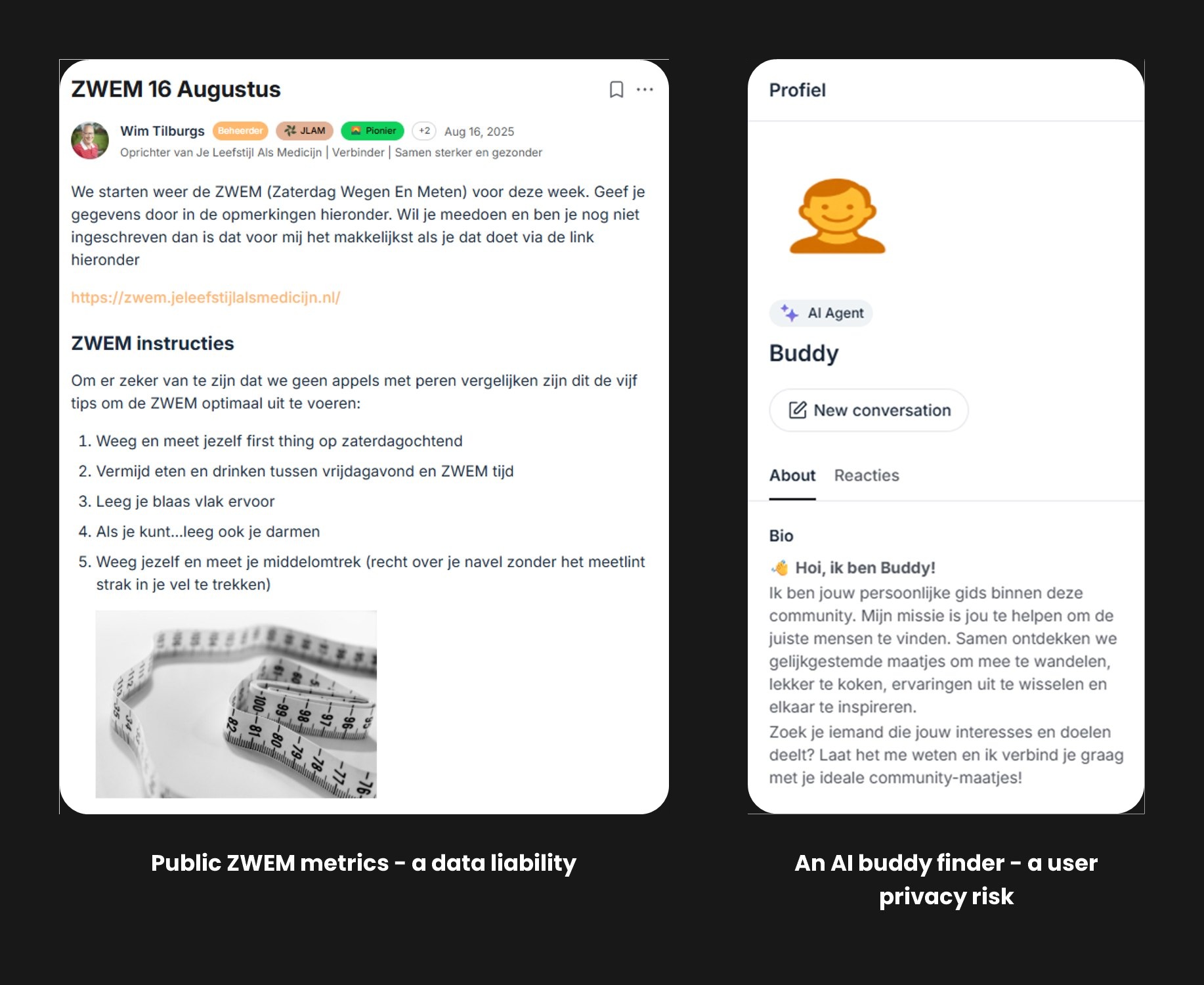
The netnography also surfaced concrete ethical problems: members posting sensitive ZWEM biometrics (weight, waist, glucose, HbA1c) publicly in forum comments, a Buddy AI matching people into friendships without meaningful consent, and three in-app AI 'assistants' that all turned out to be ChatGPT with a persona layer - discoverable only by asking.
What the netnography surfaced
Two of the findings that started the project: ZWEM health measurements posted publicly in the forum, and Buddy, an AI agent matching members into friendships without meaningful consent.
The diabetic ecosystem
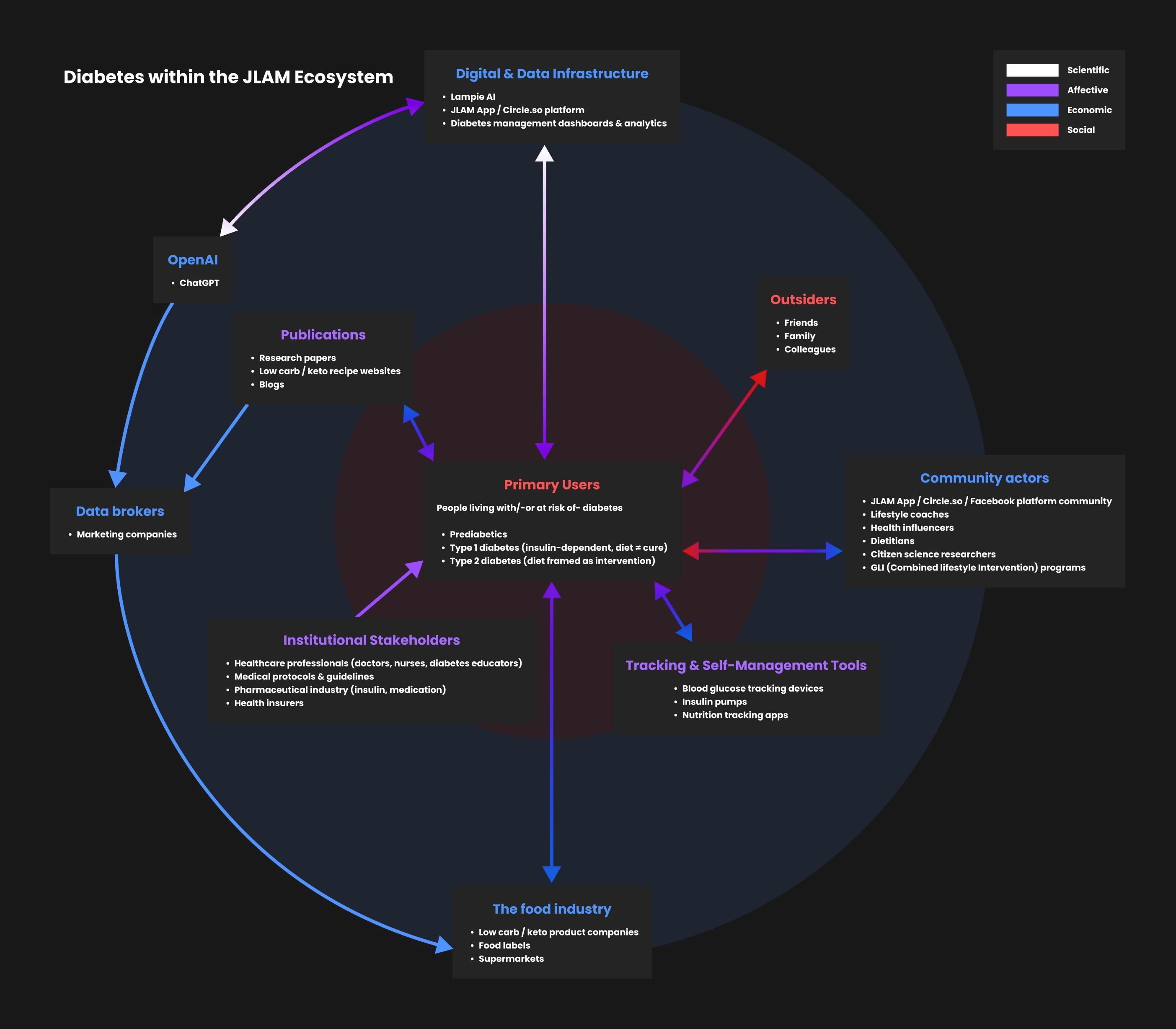
Before defining any problem I mapped every actor around a JLAM member - institutional stakeholders, community actors, tracking tools, data brokers, publications and the food industry - and the social, affective, economic and scientific value each exchange carries. The tensions in this map, like medical authority versus AI guidance and social support versus accuracy, became the ethical guardrails for everything designed after it.
The patient journey
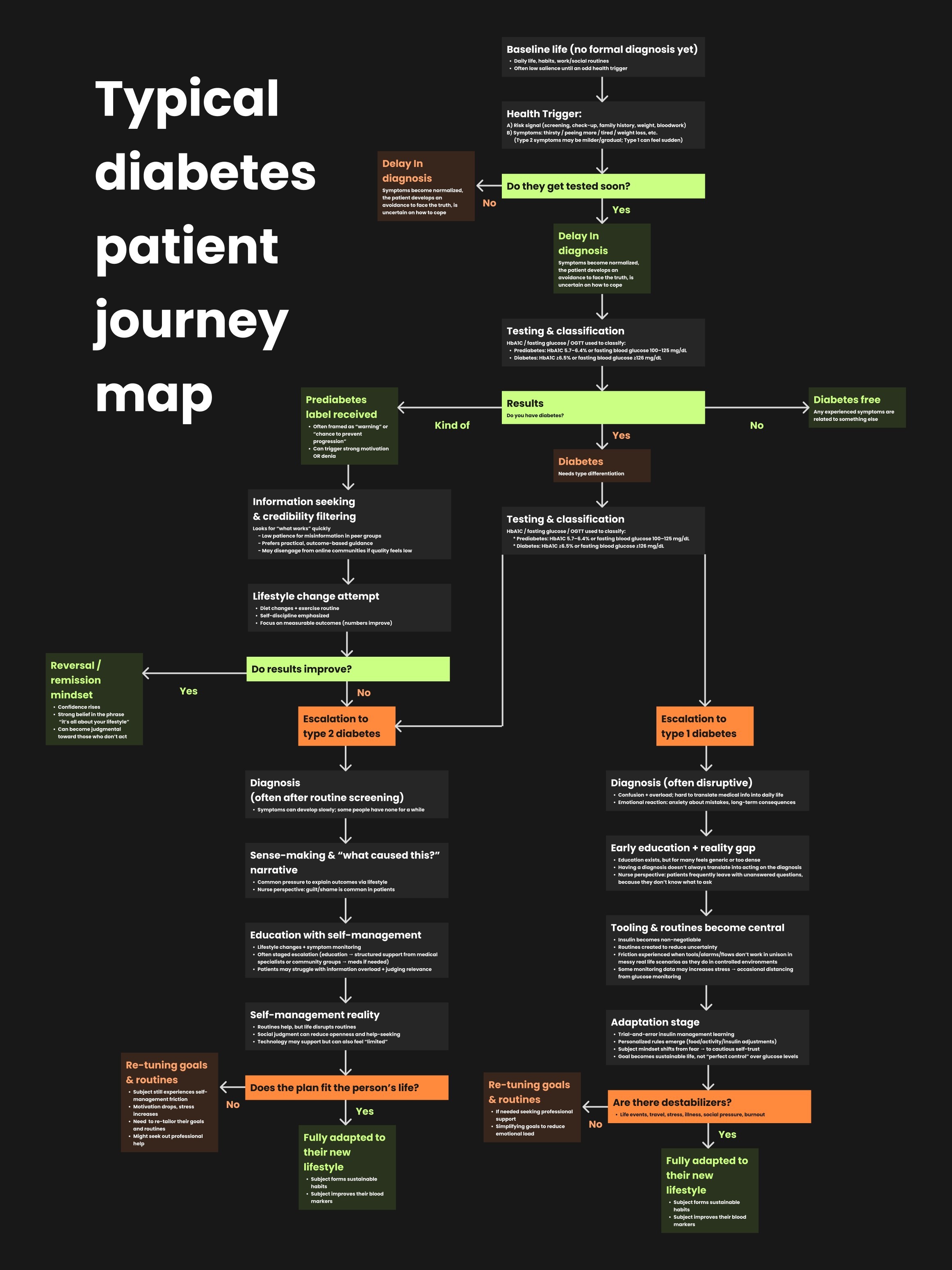
To understand where digital support actually fits, discovery also mapped the typical diabetes patient journey - from the first health trigger through diagnosis, education and long-term adaptation.
Define
The insights condensed into five defined problems: datafication risk around ZWEM health data, information asymmetry with AI chatbots, trust that collapses when AI can't be corrected, friend-matching without consent, and under-utilised recipes.
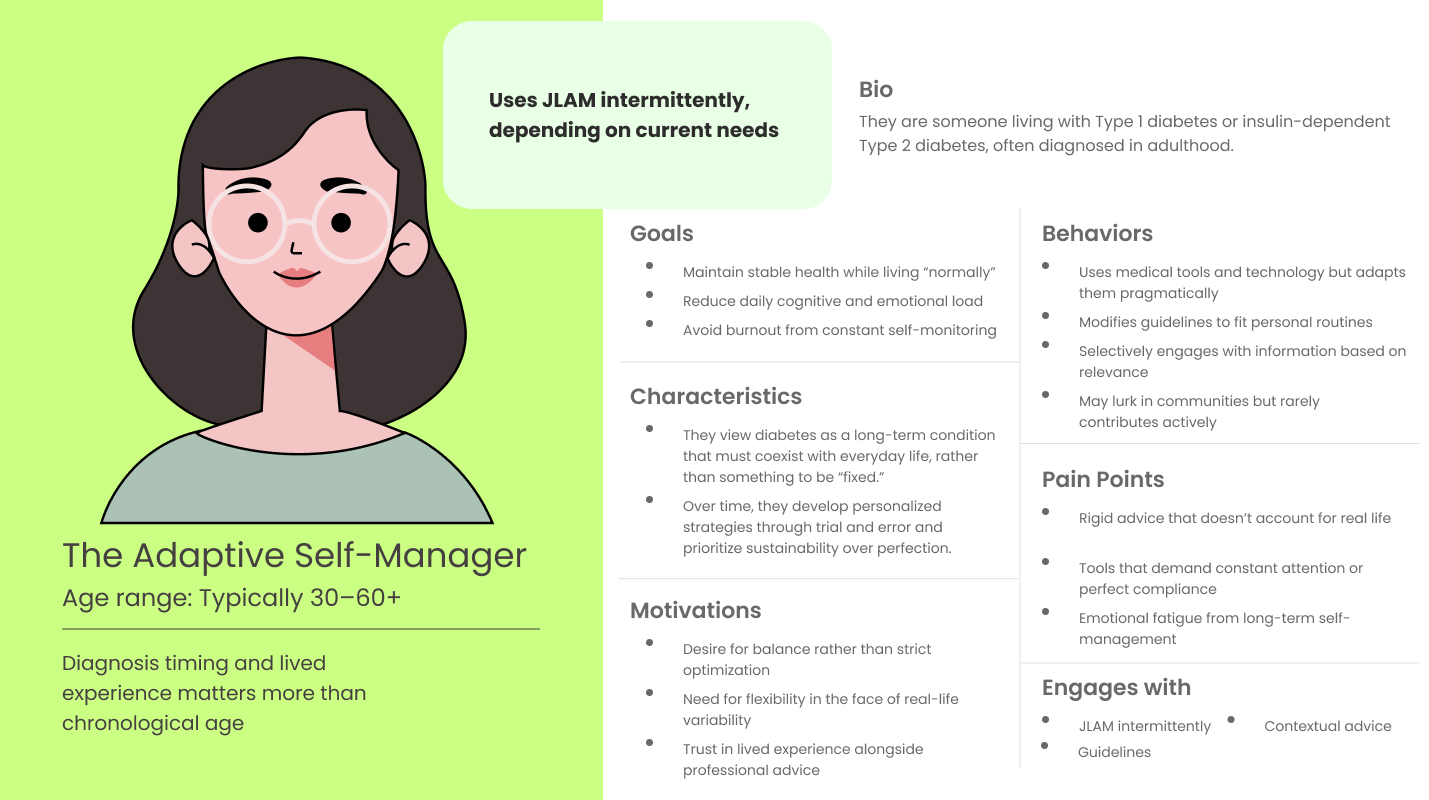
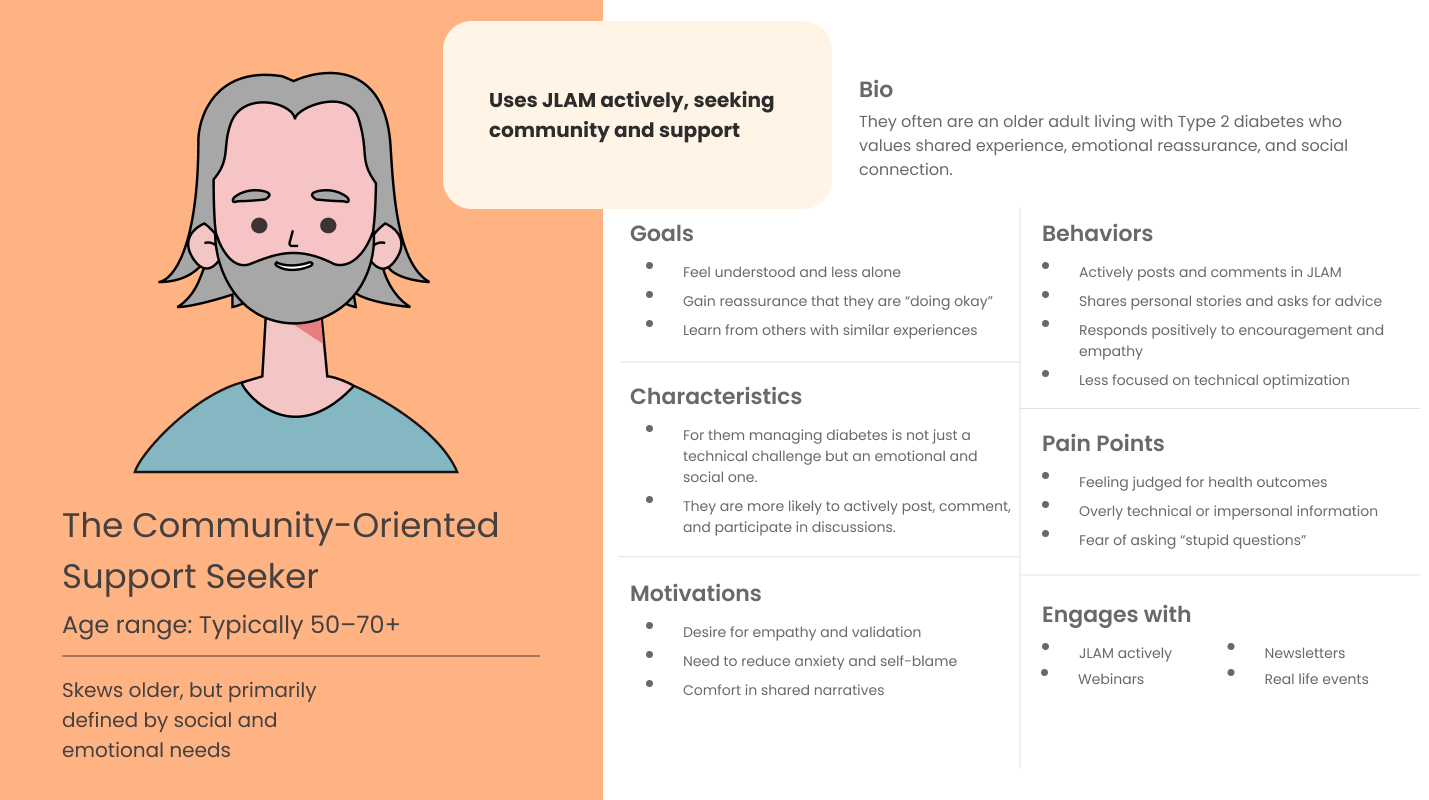
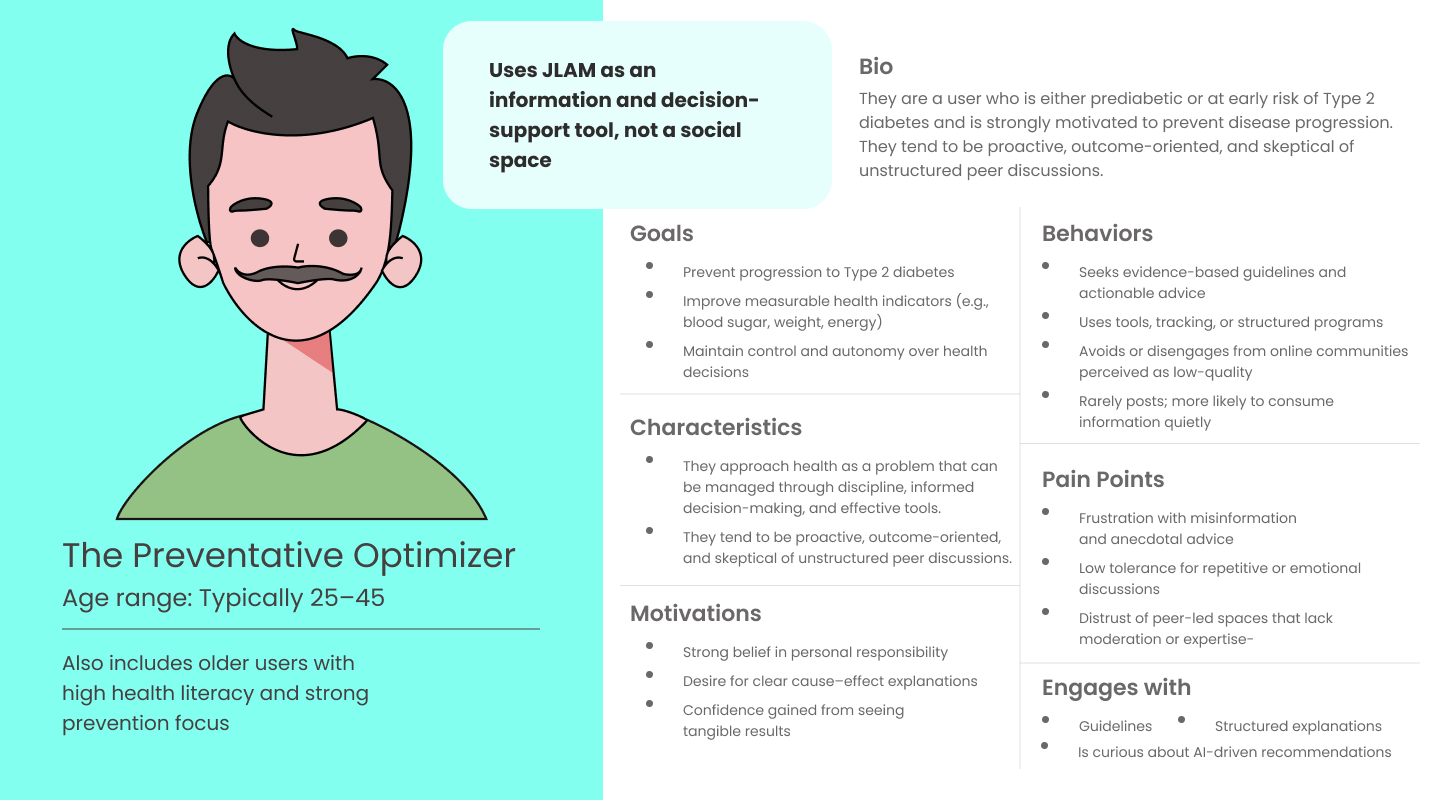
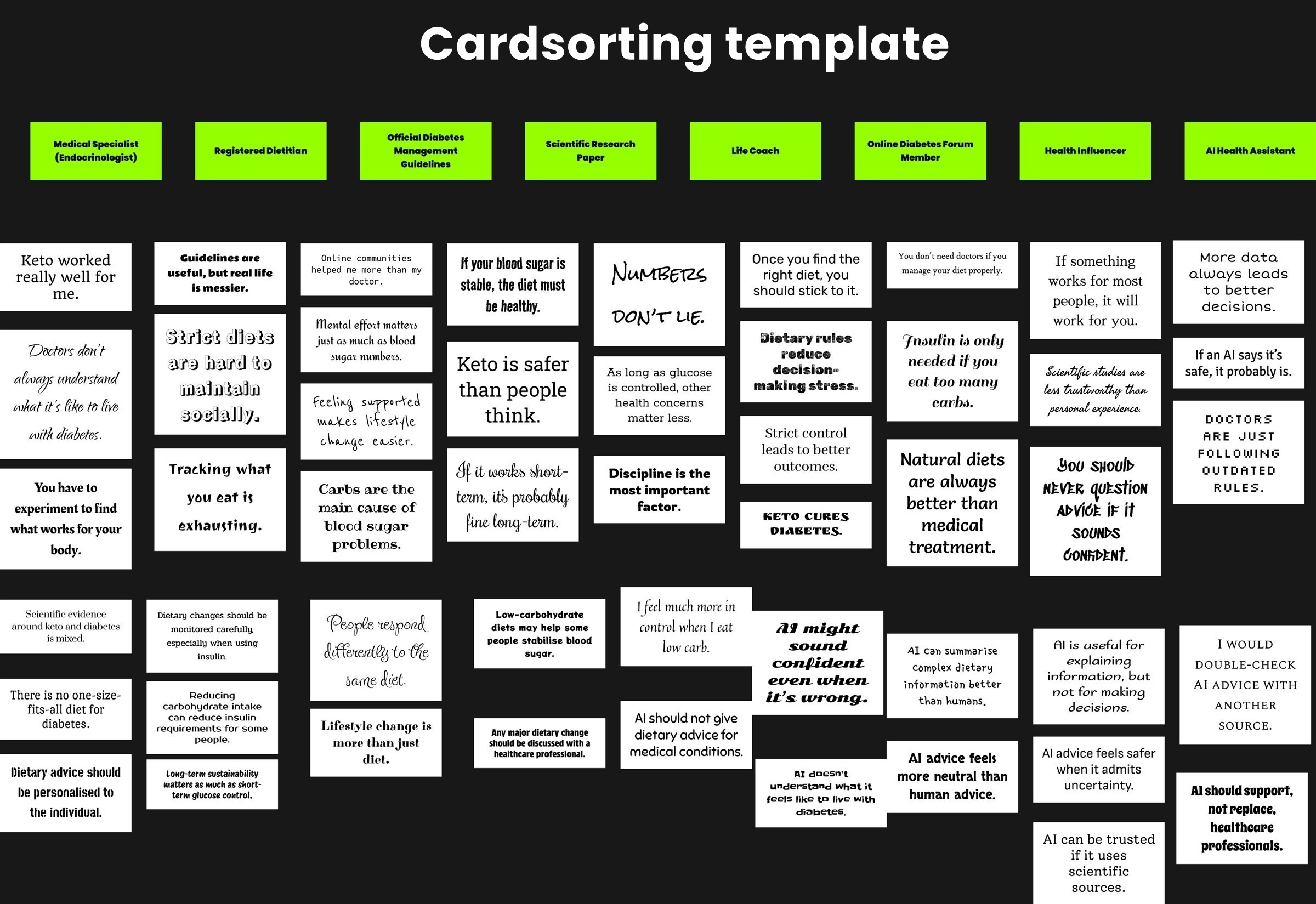
A card-sorting session with ten participants - analysed with PCA and k-means clustering - revealed three trust orientations (expert-oriented, community-oriented and mixed/skeptical), which were triangulated into three personas: the Preventative Optimizer, the Adaptive Self-Manager and the Community-Oriented Support Seeker. They describe how people seek, trust and act on dietary information - engagement styles, not diagnoses.
Everything came together in one question: how might we support sustainable dietary change in the JLAM community through ethical, trustworthy AI?
The three research personas
The interviews and the card-sorting clusters above condensed into three personas: the Adaptive Self-Manager, who dips in and out of JLAM as life changes; the Community-Oriented Support Seeker, who is there for people as much as for advice; and the Preventative Optimizer, who treats it as an information and decision-support tool. Each persona carries its own goals, frustrations and attitude towards AI, and every later design decision was checked against all three. Tap a card to view it full size.
Develop
Together with people with diabetes I ran a co-design workshop using value dams and flows; affinity diagramming showed what users actually want: data ownership, honest AI, organic connection instead of algorithmic matching, and tracking that doesn't feed obsession. From there the design went through three prototype versions.
Version 1 tested a chatbot-only MealCoach and deliberately light onboarding: to log or analyse a meal you talked to the AI, which made the feature feel opaque, and onboarding asked for personal data without explaining why.
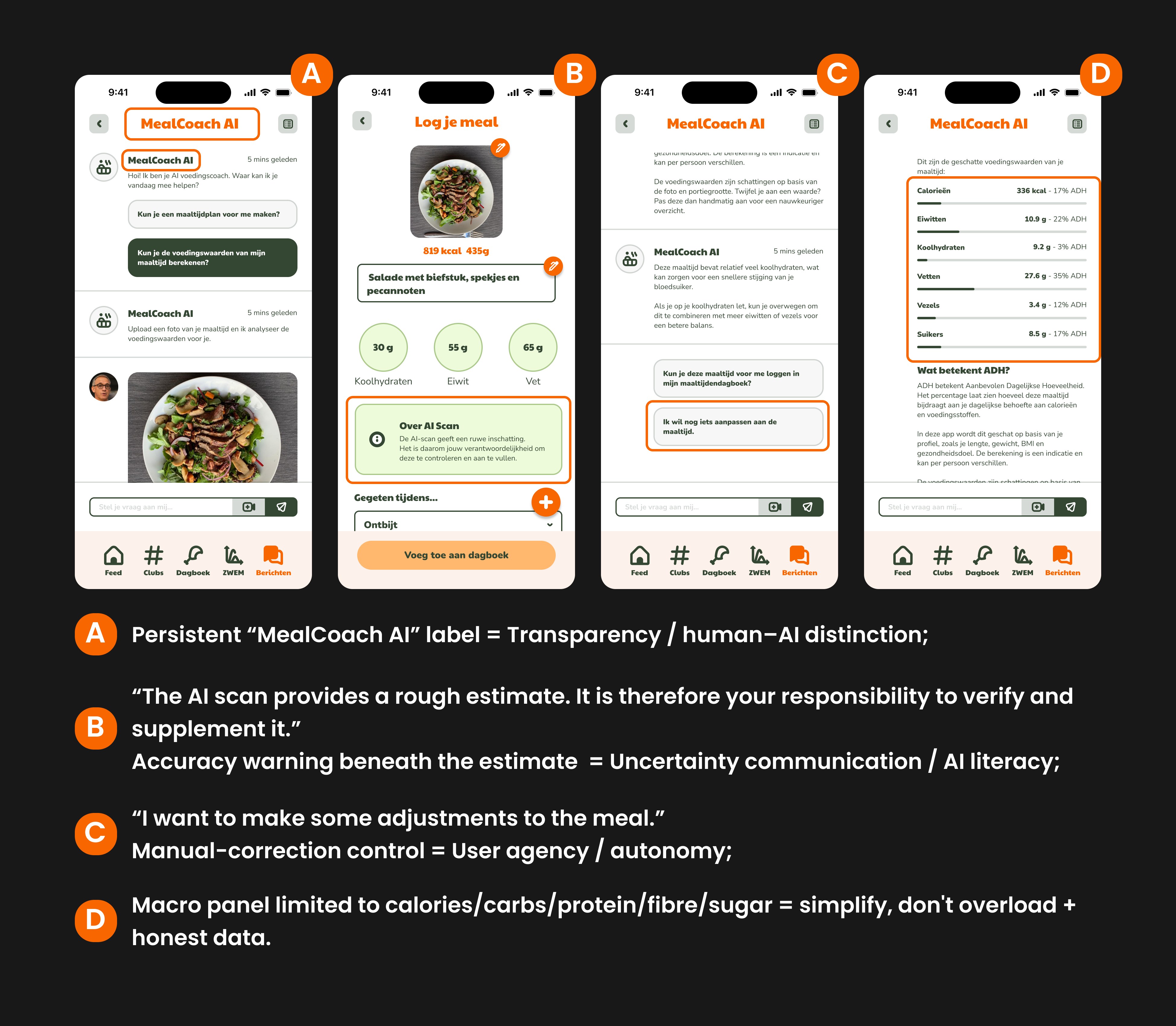
Version 2 rebuilt MealCoach from a chatbot into a proper manual meal tool that AI enhances rather than replaces: barcode scanning, food-database search and custom entry next to the AI photo scan, with AI-vision limitations stated up front. JLAMs ZWEM metrics were reframed around data ownership - biometrics stored on the user's own device, never required to be shared, exportable and deletable on demand - and the UI was made more legible.
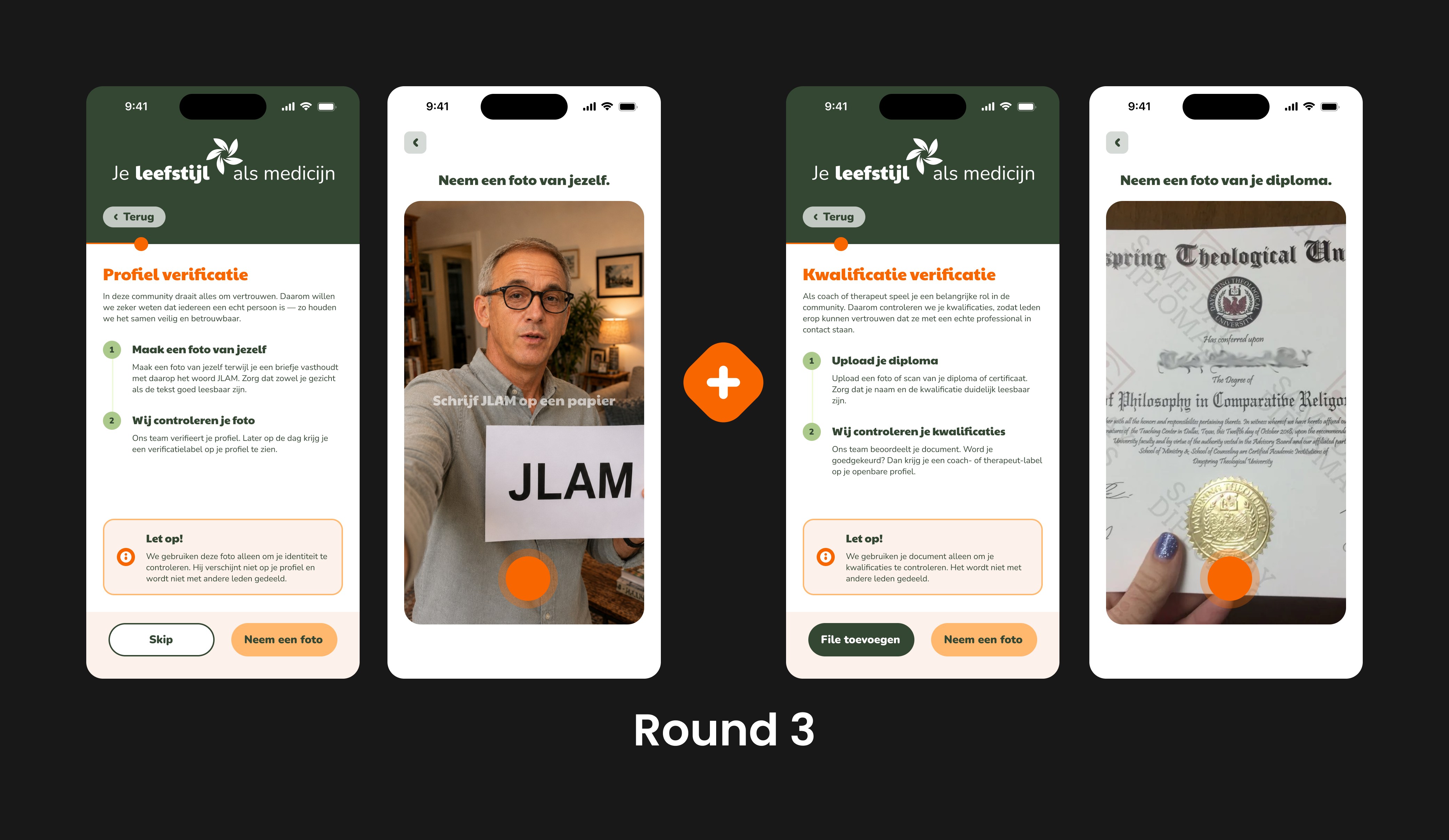
Version 3 added profile-visibility controls, identity verification, coach credential verification and a report-user affordance, and made AI disclosure continuous: assistants renamed to 'MealCoach AI' and 'ZWEMCoach AI', with an AI privacy screen right before first use - aligning with the transparency expectations of the EU AI Act.
Humans, verified
Round 3 also added human verification to the community: members prove they are a real person with a photo check, and coaches upload their qualifications before receiving a therapist label.
Test
Each prototype version got its own testing round.
Round 1 - an expert benchmark against JLAM's two existing apps - confirmed the hybrid's strengths in metric tracking and general UI, but exposed the chatbot-only MealCoach as under-explained: an AI-only meal flow triggered skepticism, pointing directly to the manual paths added in version 2.
Round 2 - six user sessions plus an eight-person survey poll - delivered the standout finding: people who walked through the flows rated MealCoach trust at 4.25/5, while people who only saw a walkthrough sat around the neutral midpoint at 3.48. The transparency cues that earn trust are invisible from the outside - they work when actually experienced.
Round 3 - a remote confirmation survey - landed feature success between 80% and 93%, with identity protection, onboarding, manual meal tracking and AI disclosure scoring highest. The two lowest items, both at 80%, were the historically trust-sensitive areas - coach vetting and AI-enhanced metric tracking - marking the remaining frontier rather than a failure. Overall app score: 4.40/5.
Testing round 1 - the expert benchmark
V1 was tested in 11 one-on-one sessions with experts in diabetes, keto, diet and other chronic conditions. We walked through my app next to JLAM's old and new apps, part by part - registration, meal tracking, metric tracking, friend finding and general UI - and rated each part on Harris profiles from 1 to 5 for trust, ease, usefulness, clarity and aesthetics. The heatmap below shows where V1 stood: solid tracking and UI, but a chatbot-only MealCoach and an onboarding that people did not find useful.
Testing round 2 - the general public
V2 was tested with 6 one-on-one sessions plus 8 survey poll responses from the general public, using the same Harris profiles. Every feature scored higher than in round 1 - the redesigned MealCoach made the biggest jump - and only the deliberately de-scoped buddy feature dipped slightly in the combined numbers.
Testing round 3 - the confirmation survey
Fifteen people from the general public completed task sets in the V3 prototype on their own, then answered a yes/no question per design objective and gave an overall 1-5 score. The binary questions kept people focused on whether each objective was achieved instead of tiny details: 80-93% answered yes per feature, and the app scored a mean of 4.40 out of 5.
The poster presentation
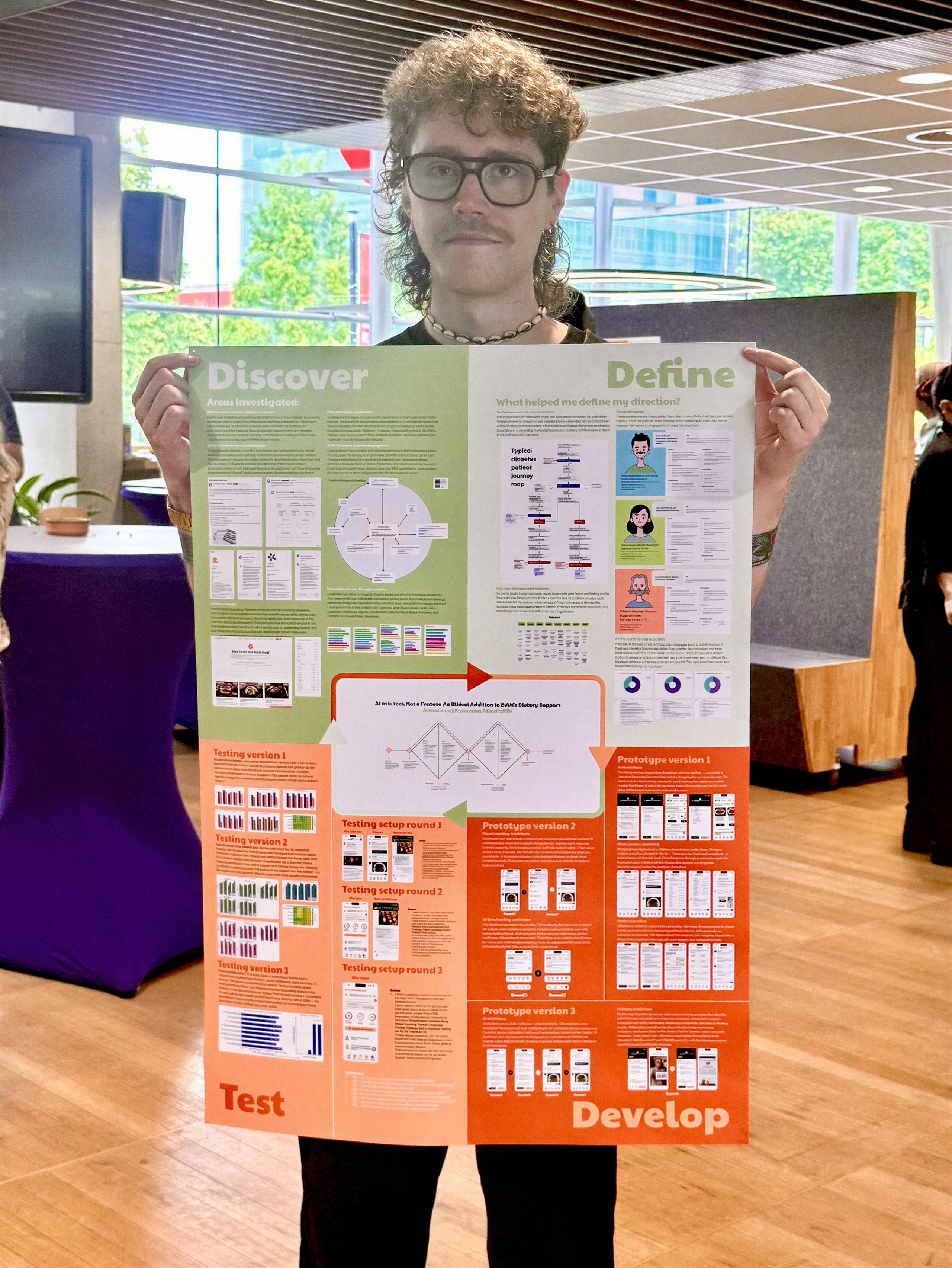
AI as a Tool, Not a Feature was my master's graduation client project - a full year of research, design and testing with JLAM that was graded an 8. I still volunteer as a UX consultant for the organisation two to three times a month. And if you would like to see this case study in a more visual format, the full poster is on Figma: